
Why do I walk away from some conversations so energized?
Not just energized, but optimistic. Like something clicked into place.
And why do other conversations, even perfectly polite ones, leave me inexplicably flat?
I’ve come to realize this spark is what I value more than almost anything else in friends, collaborators, and especially co-founders. It’s the thing people usually call chemistry, but chemistry is mysterious. Vague. Too often associated with dating and romance.
The collaborator spark is when two people can effortlessly lift each other up.
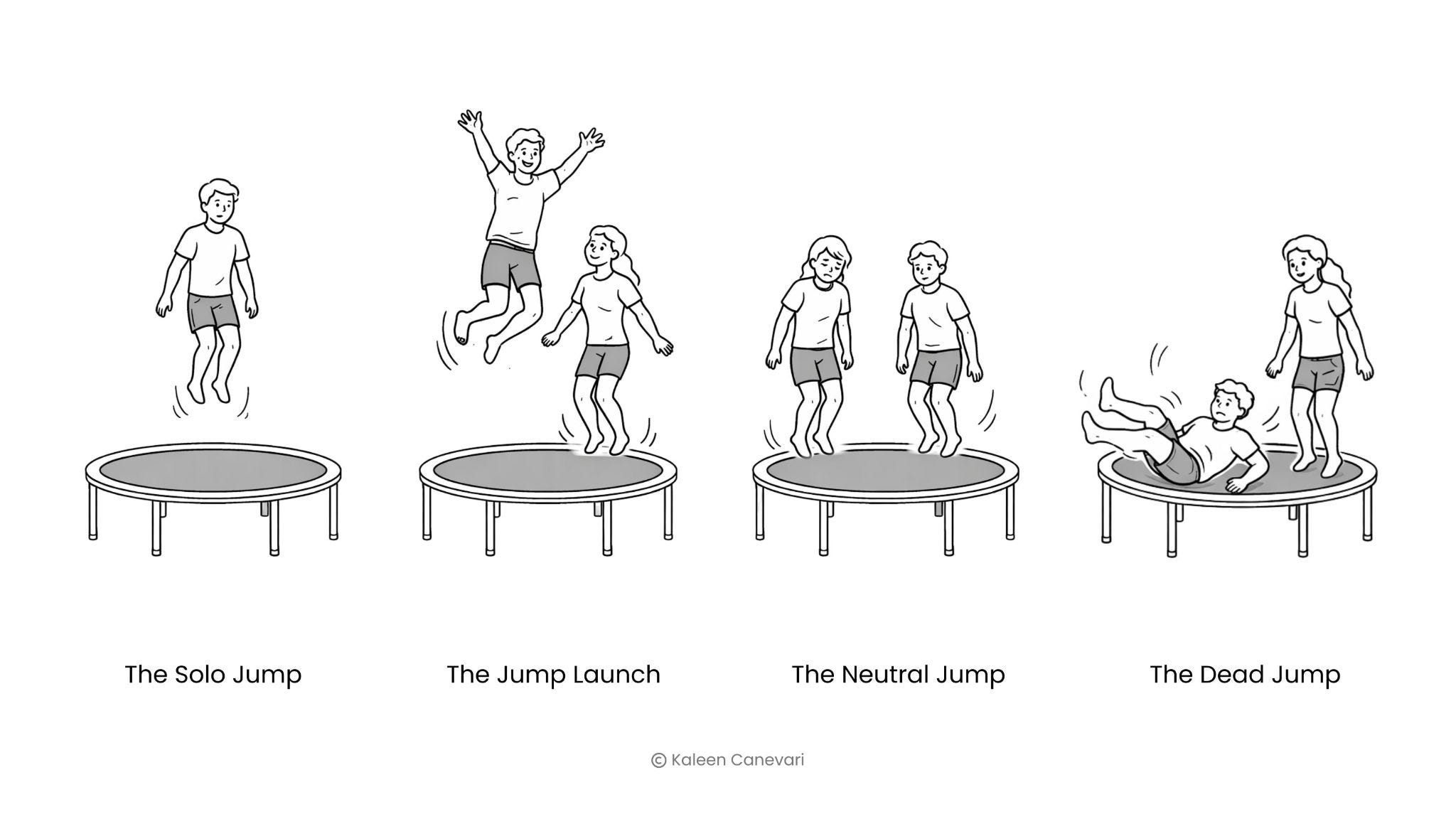
The best way I’ve found to explain it is with a trampoline.
The Analogy
Alone, you can only jump so high on a trampoline.
Add a second person, and one of three things happens:
They amplify your jump with that magically timed jump of their own that launches you gleefully into the air.
They do nothing but jump beside you. It’s nice, but neither of you are jumping any higher than before.
Their jumps time just perfectly to deaden your own, preventing you from reaching the height you were at alone.
The trampoline doesn’t change. Your strength doesn’t change.
The only variable is who is jumping with you.
Founder relationships work the same way.
Amplifying the Jump (The Spark)
This is the magic.
With the right person, your conversations build energy. Ideas don’t just survive contact, they come back stronger. You feel braver mid-thought. You say things you didn’t know you believed until you hear yourself say them out loud.
This is what great co-founder chemistry actually is.
A great co-founder builds you up. With David, my ideas were amplified. And, I’d like to think I helped amplify his own.
Not because he always agreed, but because he had that way about him that comedians refer to as “yes, and…”
He knew when to let something run, when to reflect it back, and when to apply pressure without killing lift.
In trampoline terms: our jumps launched each other higher than we could jump ourselves.
Sometimes it was accidental, sometimes intentional. But our jumps meshed together in a way that amplified what we were building.
That’s the spark. Once you’ve felt it, it becomes the standard every other interaction is measured against.
Jumping in Parallel (The Neutral Fit)
This is where most collaborations live.
Nothing is wrong. You get along. You communicate. You make progress. But there’s no real lift. You’re both jumping but it’s rare that one of your jumps lifts the other higher.
In kids, this looks like parallel play.
You’re aligned enough to move forward, but not connected enough to be greater than the sum of your two parts.
Neutral fits are tricky because they don’t set off alarms. Over time, they can be frustrating because you may feel like you should be getting further, faster.
No spark. No amplification. Just motion. Hopefully in the forward direction.
The Dead Jump (The Bad Fit)
This is the most damaging and exhausting dynamic.
A bad-fit co-founder doesn’t just fail to amplify you. They actively hold you back. Not necessarily out of malice or incompetence, but because your timing never quite lines up.
Ideas get critiqued too early. Skepticism arrives before exploration. Advice interrupts momentum. Conversations flatten instead of lift, and you find yourself thinking more about how to get through to the other person rather than building the thing.
I’ve been there.
What makes this especially hard is that you’re not just failing to accelerate, you’re spending energy counteracting friction. Every idea feels heavier than it should. You start doubting things that don’t deserve doubt. Progress becomes work instead of flow.
Why Timing Matters More Than Intelligence
The biggest insight for me was realizing that none of this is about who’s smarter. Just like in dating, sometimes two great people simply don’t mesh.
In startups, great feedback at the wrong moment still kills momentum. Well intentioned caution or doubt can suffocate possibility.
Early ideas don’t need gravity. They need lift.
The best collaborators intuitively know when to add force, when to stay out of the way, and when not to land on the mat at all.
How This Changed What I Look For
Once I saw this pattern, I couldn’t unsee it. Now, when I think about who I want to build with, I don’t ask:
Are they impressive?
Do they have the right resume?
Do they agree with me?
I ask myself:
Do I leave conversations with more energy or less?
Do ideas grow when we talk, or shrink?
Do we know how to build lift together and create something bigger than ourselves?
The best founder relationships feel like jumping on a trampoline with someone who understands your rhythm. Ideas come back stronger and higher each time.
The worst relationships don’t fail because someone was bad or wrong, but because the exchange was out of sync.
Choose your trampoline partners wisely.